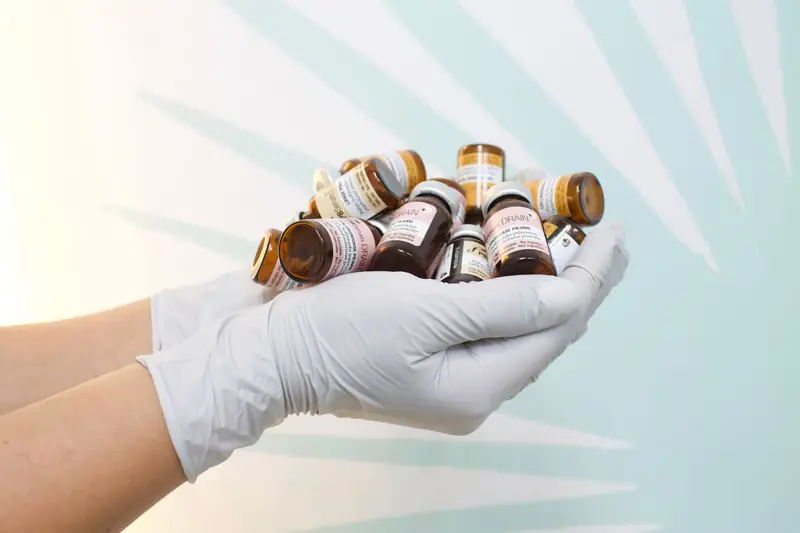
Exact standard formulation
| Ingredient | Typical dose | Mechanism of action | Osmolarity contribution |
|---|---|---|---|
| Ascorbic acid injection 500 mg/mL (buffered with sodium hydroxide to sodium ascorbate) | Immune tier 5–15 g; integrative protocols 25–50 g, occasionally higher | At normal levels an antioxidant and collagen/carnitine enzyme cofactor; at millimolar plasma levels it generates hydrogen peroxide in extracellular fluid (a pro-oxidant effect studied in oncology) | ≈ 11.4 mOsm per gram (ascorbate plus sodium); 2 mL of stock per gram |
| Sterile Water for Injection (diluent) | 250–1,000 mL for doses of about 15 g and above | Solute-free diluent that keeps a large ascorbate load from becoming dangerously hypertonic | 0 mOsm/L |
| 0.9% Sodium Chloride (carrier) | 250–500 mL for doses up to about 15 g | Prevents a low-dose bag from becoming hypotonic | 308 mOsm/L |
| Magnesium chloride 20% (optional) | 1–2 mL (200–400 mg) | Added by some protocols to reduce vein irritation and muscle twitching | ≈ 5.9 mOsm per mL |
| Zinc, B-complex (immune tier, optional) | Zinc 1–5 mg; B-complex 1 mL | Co-nutrients used in immune menus; see the zinc and vitamin C protocol | ≈ 1–2 mOsm |
Why IV and oral vitamin C are not the same
Oral vitamin C is absorbed by a saturable intestinal transporter, and the kidneys excrete the excess once plasma passes about 70 µmol/L. NIH pharmacokinetic work published in Annals of Internal Medicine in 2004 found that even maximal tolerated oral dosing keeps plasma below roughly 250 µmol/L, while intravenous dosing bypasses the gut and produced predicted peaks above 10,000 µmol/L at 50 g.
That difference is the whole rationale for high-dose IV vitamin C. At low plasma levels ascorbate acts as an antioxidant; at millimolar levels it produces hydrogen peroxide in extracellular fluid, which is the mechanism being studied in oncology. Plasma levels fall over a few hours as the kidneys clear the excess.
| Route and dose | Approximate peak plasma level | Typical use |
|---|---|---|
| Oral, 200–500 mg/day | ≈ 60–80 µmol/L (tissues near saturation) | Dietary adequacy |
| Oral, maximal tolerated doses | Below ≈ 250 µmol/L | Limited by absorption and diarrhea |
| IV, 5–15 g | Low millimolar range | Immune and wellness menus |
| IV, 50 g and above | Above ≈ 10 mmol/L (predicted) | Integrative oncology adjunct protocols, clinical trials |
Values summarized from published pharmacokinetic modeling; individual peaks vary with body size, kidney function and infusion rate.
Carrier fluid: sterile water vs saline dilution
Each gram of buffered ascorbate adds about 11.4 mOsm. At low doses that is easily absorbed by a saline bag, but at 25 g and above the ascorbate alone supplies enough solute that adding saline’s 308 mOsm/L would push the bag far past what a peripheral vein tolerates. That is why high doses are diluted in Sterile Water for Injection, and low doses are not.
| Dose | Diluent | Approx. final volume | Approx. osmolarity |
|---|---|---|---|
| 7.5 g | 500 mL NS | 515 mL | ≈ 465 mOsm/L |
| 15 g | 250 mL sterile water | 280 mL | ≈ 610 mOsm/L |
| 25 g | 500 mL sterile water | 550 mL | ≈ 520 mOsm/L |
| 25 g (wrong choice) | 500 mL NS | 550 mL | ≈ 800 mOsm/L |
| 50 g | 500 mL sterile water | 600 mL | ≈ 950 mOsm/L |
| 50 g | 1,000 mL sterile water | 1,100 mL | ≈ 520 mOsm/L |
Lactated Ringer’s is generally avoided for high-dose ascorbate because its calcium and lactate add little and complicate compatibility. See Normal Saline vs Lactated Ringer’s for carrier chemistry.
Mandatory G6PD screening above 15 g
Glucose-6-phosphate dehydrogenase (G6PD) protects red blood cells from oxidative stress. In people who are deficient, the hydrogen peroxide generated by high-dose ascorbate can trigger acute hemolysis, and published case reports include severe hemolysis with kidney failure.
- Who is at higher risk: people of African, Mediterranean, Middle Eastern and South or Southeast Asian ancestry, and males more often than females because the gene is on the X chromosome.
- Test timing: results usually take a few days, so the test is ordered at the GFE. A result taken soon after a hemolytic episode can read falsely normal.
- Once is enough: G6PD status does not change, so one documented normal result covers future infusions.
Infusion rate and duration
Integrative protocols commonly cap ascorbate at about 0.5 g per minute, with some allowing up to 1 g per minute in experienced patients. Faster rates cause vein pain, thirst, chills and lightheadedness. The first high-dose infusion is often a lower test dose, such as 15 g, before stepping up.
- 5–15 g: 30–60 minutes.
- 25 g: about 60 minutes.
- 50 g: about 90–120 minutes.
- 75 g and above: 2.5–3 hours, typically in an integrative or oncology clinic rather than a mobile setting.
Ascorbate is light- and heat-sensitive. Vials are stored per the label or pharmacy instructions and bags are mixed close to the start time. Under USP <797> immediate-use rules, a bedside mix of no more than three sterile components must start within four hours; anything more complex should come from a 503A or 503B pharmacy.
Oncology adjunct and immune protocols: the evidence
The only FDA-approved indication for an ascorbic acid injection is short-term treatment of scurvy when oral therapy is not possible. Everything else is off-label.
In oncology, pharmacologic ascorbate has been tested in early-phase trials alongside chemotherapy and radiation. The National Cancer Institute’s PDQ summary describes these studies as showing acceptable safety in screened patients with mixed, preliminary efficacy signals. Any infusion for a patient with cancer should be coordinated with the treating oncologist, since timing around chemotherapy and radiation matters.
In critical care, large trials of vitamin C for sepsis did not show benefit, and the 2022 LOVIT trial found a higher rate of death or persistent organ dysfunction in the vitamin C group. That result does not translate directly to healthy outpatients, but it is a good reason to avoid strong claims.
For immune-support visits, most menus use 5–15 g with zinc and B vitamins. The Immune Defense protocol covers that combination, and you can price it in the immune drip configurator.
Who it is for, who it is not for, and pricing context
High-dose vitamin C suits adults with normal kidney function and a documented normal G6PD result who want an immune-focused infusion, or patients enrolled in an oncologist-coordinated integrative plan. It is a poor fit for anyone with kidney stones, kidney disease, iron overload or heart failure.
A 50 g dose buffered as sodium ascorbate carries roughly 280 mmol of sodium, close to the sodium in 1.8 L of normal saline. Patients with hypertension or heart failure need that counted.
Immune-tier infusions of 5–15 g cost about $210–$290 in a lounge and $275–$375 mobile. Doses of 25 g and above are mostly offered in integrative clinics, where prices vary widely by dose and setting.
Lounge vs. mobile price benchmarks
| Setting / dose | Typical price | What is included | Notes |
|---|---|---|---|
| Lounge, 5–15 g immune drip | $210–$290 | Ascorbate with zinc and B vitamins in 250–1,000 mL | G6PD result needed before doses above 15 g |
| Mobile concierge, 5–15 g | $275–$375 | Same drip at home, hotel or office | Trip fees may apply outside the service radius |
| Integrative clinic, 25–50 g+ | Varies widely; commonly higher than immune tier | Sterile-water dilution, 1–3 hour infusion | Usually clinic-based rather than mobile |
| G6PD quantitative lab test | Lab cash prices vary; verify locally | One-time blood test ordered at the GFE | Some clinics bundle it into the first visit |
| Glutathione push add-on | +$35–$65 | 600–2,000 mg slow push after the bag | Given separately, never mixed with high-dose ascorbate |
| Group event (3–5 people) | ≈ 10% off per person | Immune-tier doses only | High-dose tiers are not suited to group events |
Prices are national self-pay medians; the drip configurator applies your state’s regional index, add-ons and group tiers.
Mandatory screening & contraindications
Required before the infusion
- Quantitative G6PD result documented before any dose above 15 g
- Kidney function (serum creatinine / eGFR) and history of kidney stones before high-dose tiers
- Good Faith Exam by an MD, DO, NP or PA, with oncologist coordination for patients in cancer treatment
- Medication review, including chemotherapy, warfarin, deferoxamine and insulin (glucose meter interference)
- Iron status history (hemochromatosis or transfusion-related iron overload)
- Baseline vital signs and fluid-status assessment, rechecked during and after infusion
Contraindications & stop signals
- Absolute: G6PD deficiency (or unknown G6PD status) for doses above 15 g
- Absolute: renal insufficiency or dialysis (oxalate nephropathy risk)
- Absolute: history of oxalate kidney stones for high-dose tiers
- Relative: hemochromatosis or iron overload (ascorbate increases iron mobilization)
- Relative: heart failure or uncontrolled hypertension (sodium and fluid load)
- Relative: insulin-treated diabetes (false fingerstick glucose readings)
- Relative: pregnancy (no data for high-dose IV use)
Configure this protocol for your group or event
Choose mobile or lounge, volume, add-ons and participants; the estimate, safety flags and printable brief update instantly and carry into your booking request.
Where this protocol is in demand
High-dose vitamin C demand clusters in metros with large integrative medicine and cold-and-flu season concierge markets.
For clinics offering this drip: USP <797> Sterile Compounding Compliance and Immediate-Use Rules for IV Hydration Clinics · FDA Section 503A vs 503B Outsourcing Facilities: Sourcing Sterile IV Nutrients Legally · Clinical Standing Orders, Inclusion and Exclusion Criteria, and Emergency Protocols for Mobile IV.
Frequently asked questions
Why do I need a G6PD test before high-dose vitamin C?
People with G6PD deficiency can develop hemolysis, a destruction of red blood cells, when exposed to the oxidative stress of high-dose IV ascorbate. A documented normal result is required before doses above 15 g, and many clinics require it for any high-dose infusion.
Why is high-dose vitamin C mixed in sterile water instead of saline?
At 25 g and above, the ascorbate itself provides enough solute to make the bag hypertonic. Adding it to saline would push osmolarity far higher, so sterile water is used as the diluent; low doses still go in saline to avoid a hypotonic bag.
Is IV vitamin C better than taking it by mouth?
It reaches much higher blood levels; published modeling puts IV peaks roughly 30 to 70 times above what oral dosing can achieve. Whether those levels improve health outcomes is still being studied, and for everyday nutrition oral intake is adequate.
Can IV vitamin C treat cancer?
It is not approved to treat cancer. Early-phase trials have tested it as an add-on to chemotherapy with mixed results, and any use should be coordinated with your oncologist.
Will IV vitamin C affect my blood sugar readings?
High plasma ascorbate can falsely raise readings on some fingerstick glucose meters for several hours. If you use insulin, confirm with a laboratory test or wait before acting on a meter reading.
How long does a 25 g vitamin C infusion take?
About an hour at a typical maximum rate of 0.5 g per minute. A 50 g dose usually takes 90 minutes to two hours.
Sources & standards reviewed
- Padayatty SJ, et al. Vitamin C pharmacokinetics: implications for oral and intravenous use. Annals of Internal Medicine, 2004 American College of Physicians
- Intravenous High-Dose Vitamin C (PDQ®) – Health Professional Version National Cancer Institute
- Vitamin C: Fact Sheet for Health Professionals NIH Office of Dietary Supplements
- Lamontagne F, et al. Intravenous Vitamin C in Adults with Sepsis in the Intensive Care Unit (LOVIT). New England Journal of Medicine, 2022 Massachusetts Medical Society
- Ascorbic acid injection prescribing information (scurvy indication) U.S. Food and Drug Administration
- USP General Chapter <797> Pharmaceutical Compounding—Sterile Preparations USP
Reviewed under the IVConnection clinical and regulatory review policy. Report a correction to clinical@ivconnection.com.