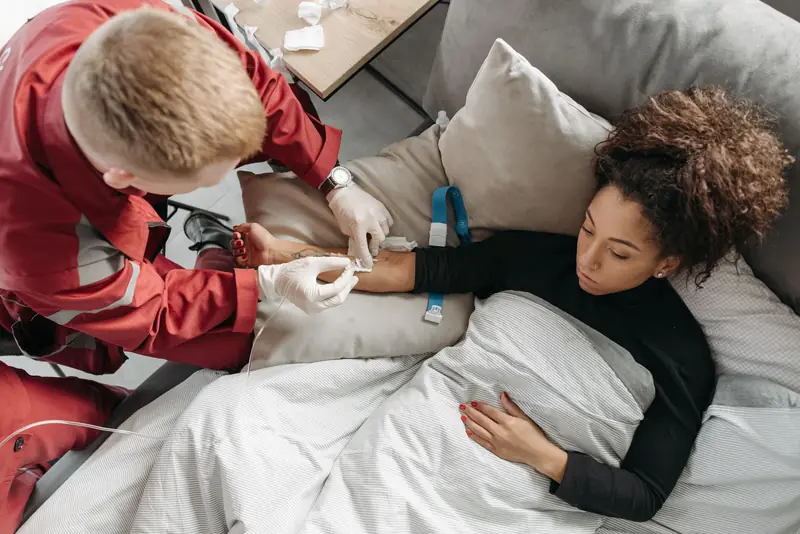
Exact standard formulation
| Ingredient | Typical dose | Mechanism of action | Osmolarity contribution |
|---|---|---|---|
| Lactated Ringer’s (carrier) | 1,000 mL | Replaces water and electrolytes lost to alcohol-driven diuresis, vomiting and sweating; lactate is converted to bicarbonate | ≈ 273 mOsm/L |
| Vitamin B-complex 100 | 1 mL | Replaces B vitamins whose intake and absorption fall with heavy drinking | ≈ 1.5 mOsm |
| Thiamine (B1), additional | 100 mg | Cofactor for carbohydrate metabolism; given before any dextrose in heavy drinkers to protect against Wernicke’s encephalopathy | ≈ 0.6 mOsm |
| Magnesium sulfate 50% or magnesium chloride 20% | 1 g | Replaces urinary magnesium losses from alcohol; low magnesium also raises QT risk with ondansetron | ≈ 8–15 mOsm |
| Vitamin B12 (often IM) | 1,000 mcg | Cofactor in energy metabolism; commonly a separate intramuscular injection | Not in the bag if given IM |
| Rx: Ondansetron (Zofran) 2 mg/mL | 4–8 mg slow IV push over 2–5 min | Serotonin 5-HT3 receptor antagonist; blocks nausea and vomiting | Negligible |
| Rx: Ketorolac (Toradol) 15 mg/mL or 30 mg/mL | 15–30 mg IV, after volume is restored | NSAID; inhibits COX-1 and COX-2 to reduce headache and body aches | Negligible |
| Rx (optional): Famotidine | 20 mg IV | H2 blocker for alcohol-related stomach irritation | Negligible |
Rehydration physics and what a hangover actually is
Alcohol suppresses vasopressin (antidiuretic hormone), so the kidneys excrete extra water while blood alcohol is rising. Vomiting, sweating, and poor fluid intake overnight add to the deficit. A liter of Lactated Ringer’s replaces that volume within an hour, far faster than a patient who is still nauseated can drink it.
Crystalloid does not stay in the bloodstream. Within roughly half an hour, most of a liter of LR spreads into the tissue fluid around cells, leaving about a quarter in the circulation. That is enough to correct mild to moderate dehydration in a healthy adult, which is why one liter is the standard and a second liter needs a specific reason.
Dehydration is only one part of a hangover. Research reviews describe inflammatory signaling, disrupted sleep, low-grade stomach irritation, congeners in darker drinks and mild drops in blood sugar as contributors. Hangover severity correlates only weakly with dehydration markers, which explains why fluids help some symptoms more than others.
Acetaldehyde clearance and B-vitamin replenishment
The liver breaks ethanol down to acetaldehyde with alcohol dehydrogenase, then to acetate with aldehyde dehydrogenase. That enzyme pathway runs at a roughly fixed rate, typically cited as about 0.015–0.020 g/dL of blood alcohol per hour. IV fluids, vitamins and glutathione do not speed it up. A provider who claims a drip “flushes out” alcohol or acetaldehyde is overstating what it can do.
B vitamins are included because heavy drinking reduces dietary intake and absorption, especially of thiamine. Thiamine matters most for patients who drink heavily on a regular basis: giving dextrose to a thiamine-deficient person can precipitate Wernicke’s encephalopathy, so protocols give thiamine first whenever glucose is involved.
A systematic review in the BMJ found no compelling evidence that any conventional or complementary intervention prevents or treats hangover. The honest description of this drip is that it rehydrates, may relieve nausea and headache when prescription drugs are added, and helps people feel better sooner. It does not reverse alcohol’s effects.
Carrier fluid, infusion rate and duration
Lactated Ringer’s is the usual carrier because its chloride is close to plasma and its lactate acts as a buffer. 0.9% Sodium Chloride is a reasonable alternative, and a prescriber may prefer it after repeated vomiting, which depletes chloride. Sterile water is never used for a hydration drip. The NS vs LR comparison covers the details.
| Step | Timing | Notes |
|---|---|---|
| Intake, vitals, GFE confirmation | 5–10 min | Screen for intoxication and red flags first |
| Ondansetron slow push (if ordered) | 2–5 min, early in the visit | Lets the patient settle before the bag runs |
| 1,000 mL LR with vitamins and magnesium | 30–45 min | 22G or 20G catheter by gravity |
| Ketorolac (if ordered) | After much of the liter is in | Kidney protection: correct volume first |
| Observation | 10–15 min | Recheck vitals; no driving if still impaired |
Good Faith Exam rules for ondansetron and ketorolac
Ondansetron and ketorolac are prescription drugs. A registered nurse cannot decide on their own to give them; each requires a patient-specific order from an MD, DO, NP or PA after a Good Faith Exam, usually by synchronous telehealth for mobile visits. Unlike a stable vitamin protocol, many medical directors require a fresh GFE for every encounter that includes these drugs.
Red flags: when a hangover visit becomes a 911 call
A mobile nurse’s first job is to decide whether this is a hangover at all. These findings mean the drip is not started and the patient is referred to emergency care:
- Still visibly intoxicated, confused, very drowsy or unable to consent.
- Vomiting blood or material that looks like coffee grounds, or black stools.
- Severe upper abdominal pain, especially radiating to the back (possible pancreatitis).
- Chest pain, fainting, a very fast or irregular pulse, or low blood pressure that does not respond.
- Tremor, sweating, agitation or hallucinations in a daily heavy drinker (possible withdrawal).
- Suspected drug co-ingestion, head injury from a fall, or a seizure.
The nurse follows the practice’s emergency standing orders and documents the referral.
Lounge vs mobile pricing and who it suits
Benchmarks are $195–$265 in a lounge and $250–$350 mobile, with prescription add-ons at about $30–$45 each when not included. Hotel visits in Las Vegas, Miami, Nashville, New Orleans and Scottsdale cluster on weekend mornings, so expect surge or minimum-order pricing at peak times.
Group bookings (bachelor and bachelorette parties, conference groups) usually get 10–20% off per person. Every participant still needs an individual GFE and screening; a group discount never replaces individual clearance. Staffing and logistics are covered in the group events guide.
The drip suits a healthy adult who is no longer intoxicated, has mild to moderate dehydration and nausea, and has none of the red flags above. Configure a visit in the recovery drip configurator, or compare the migraine protocol if headache is the main complaint.
Lounge vs. mobile price benchmarks
| Setting | Typical price | What is included | Notes |
|---|---|---|---|
| In-clinic lounge | $195–$265 | 1 L LR, B vitamins, magnesium, nurse monitoring | Some menus include ondansetron in the base price |
| Mobile concierge (home or hotel) | $250–$350 | Same drip in your room or home | Weekend morning surge or minimums common in resort cities |
| Rx add-on: ondansetron | +$30–$45 | 4–8 mg slow IV push | Requires GFE and prescriber order |
| Rx add-on: ketorolac | +$30–$45 | 15–30 mg IV after rehydration | Requires GFE; not for kidney, ulcer or bleeding risk |
| Glutathione push add-on | +$30–$65 | 600–2,000 mg after the bag | Does not speed alcohol clearance |
| Group (3–5 / 6–9 / 10+) | ≈ 10% / 15% / 20% off per person | One RN for small groups, two or more for larger | Individual GFE for every participant |
Prices are national self-pay medians; the drip configurator applies your state’s regional index, add-ons and group tiers.
Mandatory screening & contraindications
Required before the infusion
- Confirmation that the patient is no longer intoxicated and can give informed consent
- Good Faith Exam by an MD, DO, NP or PA, repeated per encounter when ondansetron or ketorolac is ordered
- Red-flag screen: GI bleeding, severe abdominal pain, chest pain, withdrawal signs, head injury, co-ingestion
- Medication review: SSRIs, SNRIs and other serotonergic or QT-prolonging drugs, anticoagulants, NSAIDs or aspirin already taken
- Kidney, ulcer, bleeding and heart rhythm history
- Baseline blood pressure, heart rate, SpO₂ and temperature; fingerstick glucose if diabetic or symptomatic
- Pregnancy status
Contraindications & stop signals
- Absolute: active intoxication, altered mental status or any red-flag finding
- Absolute (ondansetron): congenital long QT syndrome, apomorphine use, known hypersensitivity
- Absolute (ketorolac): active or past GI bleeding or ulcer, kidney disease, uncorrected volume depletion, NSAID or aspirin allergy, anticoagulation, pregnancy at 20 weeks or later
- Absolute (fluids): decompensated heart failure or dialysis-dependent kidney failure
- Relative: daily heavy drinking (withdrawal risk; thiamine first, low threshold for referral)
- Relative: concurrent serotonergic or QT-prolonging medications
- Relative: age 65 or older or weight under 50 kg (ketorolac dose reduced to 15 mg)
Configure this protocol for your group or event
Choose mobile or lounge, volume, add-ons and participants; the estimate, safety flags and printable brief update instantly and carry into your booking request.
Where this protocol is in demand
Hangover recovery bookings concentrate in nightlife, bachelor-party and resort hotel markets such as Las Vegas, Miami, Nashville and New Orleans.
For clinics offering this drip: Good Faith Exams and Telehealth Patient Clearance for Mobile IV Therapy · Running Group IV Events, Corporate Wellness Days & Drip Parties · Clinical Standing Orders, Inclusion and Exclusion Criteria, and Emergency Protocols for Mobile IV.
Frequently asked questions
Does a hangover IV remove alcohol from your system?
No. The liver clears alcohol and acetaldehyde at a roughly fixed rate that fluids and vitamins do not change. The drip rehydrates you and, with prescription add-ons, can relieve nausea and headache.
Do I need a prescription for Zofran or Toradol in a hangover drip?
Yes. Both are prescription drugs that need a patient-specific order from an MD, DO, NP or PA after a Good Faith Exam. Many practices require a new exam each time these drugs are given.
Can I get a hangover IV if I am still drunk?
Reputable providers will not start a drip while you are intoxicated, because you cannot give informed consent and intoxication can mask emergencies. Most hangover visits happen the morning after.
Why does the nurse wait to give Toradol?
Ketorolac can injure the kidneys when you are dehydrated, so protocols restore fluid volume first. It is also skipped if you already took ibuprofen, naproxen or aspirin that day.
How long does a hangover drip take?
About 45–60 minutes including intake, the liter of fluid and a short observation period. The bag itself usually runs in 30–45 minutes.
Is an IV better than drinking water for a hangover?
If you can keep fluids down, oral rehydration works for mild dehydration. An IV helps most when nausea or vomiting makes drinking difficult or when you want to recover faster.
Sources & standards reviewed
- Pittler MH, Verster JC, Ernst E. Interventions for preventing or treating alcohol hangover: systematic review of randomised controlled trials. BMJ, 2005 BMJ Publishing Group
- Penning R, et al. The pathology of alcohol hangover. Current Drug Abuse Reviews, 2010 Bentham Science
- Ondansetron injection prescribing information (QT prolongation and serotonin syndrome warnings) U.S. Food and Drug Administration
- Ketorolac tromethamine injection prescribing information (boxed warning) U.S. Food and Drug Administration
- Alcohol Metabolism: An Update National Institute on Alcohol Abuse and Alcoholism
- Infusion Therapy Standards of Practice Infusion Nurses Society
Reviewed under the IVConnection clinical and regulatory review policy. Report a correction to clinical@ivconnection.com.