Statutory & financial benchmarks
| Device | Typical size | Tip location | Typical use and dwell | Mobile wellness use? |
|---|---|---|---|---|
| Short peripheral IV catheter | 20G–24G for most infusions | Peripheral vein, forearm preferred | Single session for wellness drips; otherwise replaced when clinically indicated, not on a fixed schedule | Yes, the standard device |
| Ultrasound-guided long peripheral catheter | Commonly 20G–22G, longer catheter | Deeper forearm or upper-arm vein | Difficult venous access; short-term peripheral therapy | Rarely; requires ultrasound competency |
| Midline catheter | Small-French single or dual lumen | Upper-arm vein, tip at or near the level of the axilla | Peripherally compatible therapy for roughly 1–4 weeks; MAGIC favors about 6–14 days | No; home infusion with an order |
| PICC | Commonly 4–6 Fr | Lower third of the superior vena cava near the cavoatrial junction, confirmed by imaging or ECG | Weeks to months; vesicants, parenteral nutrition, long courses | No; maintenance only by trained home infusion nurses |
| Implanted port | Accessed with a non-coring needle | Cavoatrial junction | Months to years; access needle commonly changed every 7 days while accessed | No; accessed by trained RNs under orders |
Why the INS Standards are your legal yardstick
The Infusion Therapy Standards of Practice, published by the Infusion Nurses Society, reached its 9th edition in January 2024. It is not a statute, but boards of nursing, accreditation surveyors and courts treat it as the professional standard of care for anyone placing or maintaining vascular access. If your policy is weaker than the Standards, expect the gap to be quoted back to you after an adverse event.
The Standards sit alongside the CDC Guidelines for the Prevention of Intravascular Catheter-Related Infections and manufacturer instructions for each device and drug. Your medical director’s standing orders and your nursing policy manual should reference all three, and your nurses should be able to show documented competency against them.
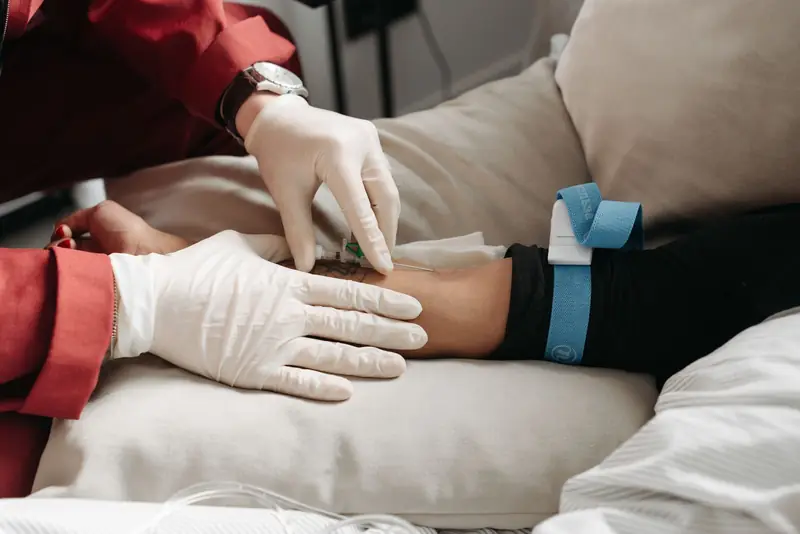
The core idea is device selection by therapy: choose the least invasive device, with the smallest gauge and fewest lumens, that will safely deliver the prescribed therapy for its expected duration. For a 500–1,000 mL hydration or vitamin drip, that is almost always a short peripheral catheter.
Site selection and catheter gauge for wellness drips
For adults, choose forearm veins first. They give stable dwell, less discomfort with movement and lower occlusion risk than the antecubital fossa or hand. Avoid areas of flexion, the volar (palm-side) wrist where nerves run superficially, veins below a previous puncture, the arm on the side of an arteriovenous fistula or graft, and any limb with impaired circulation or lymphedema unless the prescriber directs otherwise.
| Gauge | Approx. maximum gravity flow* | Where it fits in IV wellness |
|---|---|---|
| 24G | ≈ 20–25 mL/min | Small or fragile veins, older adults; slow hydration and push add-ons |
| 22G | ≈ 35–40 mL/min | Default for most 500–1,000 mL wellness and Myers’-style drips |
| 20G | ≈ 55–65 mL/min | Larger veins, faster 1 L hydration, when the prescriber wants a robust line |
| 18G | ≈ 90–105 mL/min | Rarely needed in elective settings; reserve for rapid volume replacement |
*Manufacturer bench figures for short catheters with water at gravity; real flow is lower and varies by brand, catheter length, vein size and bag height. Infusion rate is set by the order and the patient’s cardiac and renal status, never by how fast the catheter can run.
The INS Standards moved away from a single universal osmolarity cut-off for peripheral infusion; weigh osmolarity, pH and vesicant properties together. Most wellness formulations are diluted to stay peripherally compatible, but concentrated additives such as high-dose ascorbic acid need the dilution the protocol specifies. See high-dose vitamin C for an example.
The attempt limit, difficult access and nerve injury
The INS Standards limit peripheral catheter attempts to no more than two per clinician and no more than four in total. Repeated attempts cause pain, hematoma, vein damage and nerve injury, and the nerve injury claim is one of the most expensive in elective IV practice. In a mobile setting with no second clinician on site, the practical rule is simple: two failed attempts and the elective drip is rescheduled or referred, not attempted a third time.
- Predict difficulty before you stick: history of hard sticks, obesity, dehydration, chemotherapy history, IV drug use history or no visible or palpable veins. Offer vein visualization technology or an ultrasound-trained nurse up front.
- Stop on paresthesia: if the patient reports electric, shooting or radiating pain, stop and remove the catheter immediately, document the complaint and notify the medical director. Do not advance or redirect.
- Document every attempt: site, gauge, number of attempts, who attempted, and the patient’s response. An undocumented third attempt looks like a policy violation even when it was not.
Midlines and PICCs in home infusion
Midlines and PICCs belong to home infusion and specialty pharmacy work, not to elective mobile drips. Who may insert them is set by each state’s nursing scope and by the organization’s policy; many boards allow RNs with documented education and competency to place ultrasound-guided midlines and PICCs, but some impose additional conditions. Confirm your board’s position before you advertise insertion services.
A midline is a peripheral device: its tip ends at or near the level of the axilla, so it carries the same infusate limits as a peripheral IV. Avoid continuous vesicant infusions and parenteral nutrition through a midline. The Michigan Appropriateness Guide for Intravenous Catheters (MAGIC) favors midlines for peripherally compatible therapy expected to last about six to fourteen days, and PICCs for longer courses or non-peripherally compatible infusates.
A PICC is a central device. Tip position in the lower third of the superior vena cava, near the cavoatrial junction, must be confirmed before use, by chest radiograph or ECG-based tip confirmation technology. At every dressing change, measure and record the external catheter length; a change suggests migration and the device should not be used until position is checked. Measure upper-arm circumference when you suspect thrombosis (swelling, pain, venous distension) and report findings promptly.
Antisepsis, dressings and flushing
Skin antisepsis is the first infection control step for every device: chlorhexidine greater than 0.5% in alcohol, applied with friction and allowed to dry completely, unless the patient has a contraindication. Disinfect needleless connectors before every access with friction (“scrub the hub”) and allow the disinfectant’s required dry time.
| Task | Peripheral IV | Midline / PICC / port |
|---|---|---|
| Dressing | Sterile transparent dressing; replace if damp, loose or soiled | Transparent semipermeable dressing at least every 7 days; gauze dressing every 2 days; immediately if damp, loose or soiled; chlorhexidine-impregnated dressings commonly used for CVADs |
| Flush volume | At least twice the internal volume of the catheter and add-ons; 5 mL preservative-free 0.9% NaCl is common | At least twice the internal volume; 10 mL preservative-free 0.9% NaCl is common |
| Technique | Pulsatile (push-pause) flush; never force against resistance | Pulsatile flush with 10 mL-diameter syringes to limit pressure; assess for blood return before each use |
| Lock | 0.9% NaCl when the device stays in place | Saline or heparin per device manufacturer and organizational policy |
| Assessment | Before, during and after the infusion, and before removal | Every visit: site, external length, arm circumference when indicated, function |
In mobile wellness, peripheral catheters are removed at the end of the session. Check that the catheter tip is intact, hold pressure until hemostasis, and document removal. A catheter left in for a “next-day drip” turns an elective encounter into an unmonitored line in someone’s home.
Recognizing and managing complications
Field nurses work without a rapid response team, so every complication protocol has to be in the standing orders and the kit. The emergency side is covered in standing orders and emergency protocols; the device side is below.
| Complication | Early signs | Immediate action |
|---|---|---|
| Infiltration / extravasation | Swelling, coolness, blanching, tightness, slowed flow | Stop the infusion, disconnect, aspirate if protocol calls for it, remove PIV, raise the limb, grade with a standardized scale, notify prescriber; follow drug-specific extravasation orders |
| Phlebitis | Pain, erythema, warmth, palpable cord along the vein | Grade with a validated scale, remove the PIV, apply warm compress per policy, document and follow up |
| CVAD occlusion | Sluggish flush, no blood return, pump occlusion alarms | Rule out mechanical causes (clamps, kinks, position); if thrombotic and ordered, alteplase 2 mg/2 mL instilled for patients 30 kg or more, assess at 30 minutes and up to 120 minutes; a second dose may be ordered |
| Suspected bloodstream infection | Fever, chills, rigors, site drainage | Notify the prescriber and pharmacy urgently; cultures per orders; do not remove a CVAD without an order |
| Air embolism | Sudden dyspnea, chest pain, hypotension | Clamp or occlude the catheter, place the patient on the left side with head down if tolerated, give oxygen if available, call 911 |
| Nerve injury | Electric or radiating pain, numbness, tingling during insertion | Stop, remove the catheter, document, notify the medical director, arrange follow-up |
Step-by-step: building a vascular access program
- Adopt the Standards by referenceWrite your vascular access policy against the INS Standards (9th edition), CDC catheter guidelines and manufacturer instructions, and have the medical director sign it.
- Define device scopeState which devices your nurses insert, which they only maintain, and which you never touch, consistent with your state board’s scope rules.
- Validate competencyDocument initial training and annual skills validation for PIV insertion, ultrasound guidance, CVAD care and occlusion management for each nurse.
- Standardize the start kitStock 20G–24G catheters, chlorhexidine-alcohol antiseptic, transparent dressings, preservative-free saline flushes and stabilization devices.
- Write the attempt rule into protocolTwo attempts per clinician, four total, then reschedule or escalate; document every attempt.
- Screen for difficult accessAsk about prior hard sticks at booking and send an ultrasound-trained nurse or reschedule rather than improvise.
- Set the assessment routineAssess the site before, during and after each infusion, and grade any infiltration or phlebitis with a standard scale.
- Equip for complicationsCarry extravasation supplies, warm compresses and the emergency kit, and include occlusion and extravasation orders in standing orders.
- Template the documentationGauge, site, attempts, inserter, device lot, flush, assessments, removal with tip intact, patient response.
- Audit and close the loopReview infiltration, phlebitis and failed-start rates monthly and retrain nurses whose rates drift.
Common regulatory audit traps
Third and fourth attempts on an elective drip
Boards and plaintiffs read repeated attempts as a failure to follow the INS attempt limit, especially when the record shows no escalation plan. Cap attempts at two per clinician and reschedule elective drips rather than persist.
Inserting devices outside board scope
Advertising midline or PICC insertion without documented education, competency and orders, or in a state with additional conditions, invites scope-of-practice findings. Confirm your board’s position and keep competency files current.
Thin insertion documentation
“PIV placed, tolerated well” does not show gauge, site, attempts, assessments or removal. In a nerve injury or infiltration claim, missing detail is treated as care not done. Use a structured template.
Overdue CVAD dressings and unmeasured PICCs
Dressings past seven days and no external length recorded are among the most common home infusion survey findings and are linked to infection and migration. Schedule dressing changes in the visit plan and record the external length every time.
Vesicants or nutrition through a midline
Treating a midline as a central line ignores its peripheral tip position and can cause tissue injury. Match the infusate to the device and escalate to the prescriber when the therapy changes.
Run your state’s compliance and margin model
Pick your state, licence, model and volume to see the required entity structure, medical director retainer, GFE and 503B supply costs, and net margin, then get matched with the network.
State rules that matter most here
Frequently asked questions
What gauge IV catheter is best for mobile IV hydration?
A 22G catheter suits most 500–1,000 mL hydration and vitamin drips, with 24G for small or fragile veins and 20G for larger veins or faster ordered rates. The INS principle is the smallest gauge that safely delivers the prescribed therapy.
How many times can a nurse attempt to start an IV?
The INS Standards limit attempts to no more than two per clinician and four in total. In mobile elective practice, most programs stop after two failed attempts and reschedule or refer the patient.
Can RNs place midlines and PICC lines?
Many state boards allow RNs with documented education and competency to place ultrasound-guided midlines and PICCs under an order, but scope rules and conditions differ by state. Check your board’s position and your organization’s policy before offering the service.
How often should a PICC dressing be changed?
Transparent semipermeable dressings are changed at least every 7 days and gauze dressings every 2 days, and either one immediately if it is damp, loose or soiled. Measure and record the external catheter length at each change.
What is the alteplase dose for a blocked central line?
For patients weighing 30 kg or more, the labeled dose of alteplase for catheter occlusion is 2 mg in 2 mL instilled into the occluded lumen, assessed at 30 minutes and up to 120 minutes, with a second dose permitted if function is not restored. It requires a prescriber order.
Should a wellness IV be left in for a follow-up drip?
No. Peripheral catheters placed for elective drips are removed at the end of the session. Leaving a catheter in place at home without monitoring creates infection, dislodgement and misuse risk with no clinical benefit.
Sources & standards reviewed
- Infusion Therapy Standards of Practice, 9th edition (2024), Journal of Infusion Nursing supplement Infusion Nurses Society
- Guidelines for the Prevention of Intravascular Catheter-Related Infections (2011, with updates) Centers for Disease Control and Prevention
- The Michigan Appropriateness Guide for Intravenous Catheters (MAGIC), Annals of Internal Medicine, 2015 American College of Physicians
- Cathflo Activase (alteplase) prescribing information Genentech
- Vascular Access Board Certification (VA-BC) Vascular Access Certification Corporation / Association for Vascular Access
- CRNI® certification Infusion Nurses Certification Corporation
Reviewed under the IVConnection clinical and regulatory review policy. Report a correction to clinical@ivconnection.com.